


 The next set of markings aren’t really necessary to know how to read your tires – but may be interesting at the same time – are important to the Department of Transportation (DOT) and are referred to as the Tire Identification Number (TIN). The TIN is made up of sets of letters and numbers. The first two letters/numbers are always representative of the manufacturing plant. Each plant gets a two digit code – whether it’s one number and one letter, both numbers, or both letters – and it will always be the first two markings you see to the right of DOT. The next part will be a two digit code indicating the tire size. The middle four letters, JAIR in our case, identify the tire brand. And finally the last four numbers tell you what week and year the tire was made. For our example, it was made during the 37th week of the year 2006.
There are certainly other numbers on the sidewall of your tires including maximum tire pressure (which is not the same as recommended tire pressure), temperature rating, traction rating and others. These are just making you aware that the tire, if used outside of those specifications, may not perform favorably.
The next set of markings aren’t really necessary to know how to read your tires – but may be interesting at the same time – are important to the Department of Transportation (DOT) and are referred to as the Tire Identification Number (TIN). The TIN is made up of sets of letters and numbers. The first two letters/numbers are always representative of the manufacturing plant. Each plant gets a two digit code – whether it’s one number and one letter, both numbers, or both letters – and it will always be the first two markings you see to the right of DOT. The next part will be a two digit code indicating the tire size. The middle four letters, JAIR in our case, identify the tire brand. And finally the last four numbers tell you what week and year the tire was made. For our example, it was made during the 37th week of the year 2006.
There are certainly other numbers on the sidewall of your tires including maximum tire pressure (which is not the same as recommended tire pressure), temperature rating, traction rating and others. These are just making you aware that the tire, if used outside of those specifications, may not perform favorably.
How to Read Your Tires
Getting new tires but don’t know how to figure out the size? Filling your tires up with the air they’ve lost in the cold weather but don’t know how much to put in? Or just want to learn something new? Well, the information on the sidewall of your tires can be hard to decipher, but we’re here to help show you how to read your tires!
P
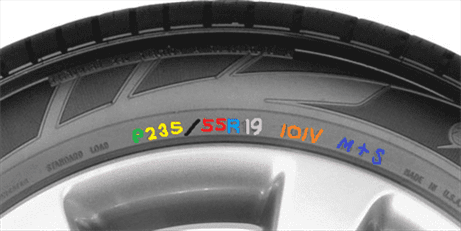
We’ll start with the numbers that indicate the size of your tire. The letter “P” labeled in this picture with a green color is the Service Description. This lets you know what kind of use the tire is intended for. Obviously it is meant for the road, but there are different letters and combinations they use. P stands for passenger car, LT stands for light truck, ST is for special trailer, and T stands for temporary. So, if you have any type of car or SUV (excluding trucks), then your tires will most likely be marked with a P, and if you look at your spare tire for either your car or SUV it will most likely have a T.
235
The second part is the number “235” labeled with yellow writing in this picture. This number simply represents the tire width in millimeters up and over the tires tread.
55
This number “55” is what’s called the aspect ratio. That ratio is made up of its section height divided by its section width. We already know its section width is 235 millimeters, so this particular tire’s aspect ratio says that its height is 55% of its width. The lower the aspect ratio the lower the sidewall height, which makes for better handling.
R
The next letter “R” refers to its internal construction and stands for radial construction. You will see an R on 99.9% of tires now-a-days because it’s been the industry standard for about 25 years. The only exception being certain large trucks that still use Bias-ply tires, represented with a B instead of an R.
19
This number, 19 in our case, stands for the rim diameter in inches. This means that this tire will only fit on a 19-inch rim.
101V
The next marking is kind of a two-in-one. The number that comes first represents the tires load index. And a tire’s load index is exactly what it sounds like: how much weight can that one tire carry. So, from here you need to do two things. First, you need to look at your number on the Load-Carrying Capacity Per Tire chart. According to the chart, our number 101 can carry 1,819 pounds. Secondly, you need to multiply that number by the number of tires on your vehicle to get a total amount of load capacity you can carry. So, the vehicle that this tire belongs to would have a maximum carrying capacity of 7,276 lbs.
The second part of this marking is a letter; a V in this case but it may be different on your vehicle. This letter indicates the speed rating. And just as you had to refer to a chart with the number, you have to do the same for the letter although this chart is not as extensive and can be seen below.
Here is a complete list of the various tire speed ratings, and their associated letters:
S = 112 mph
T = 118 mph
U = 124 mph
H = 130 mph
V = 149 mph
*Z = Over 149 mph
W = 168 mph
Y = 186 mph
(Y) = Over 186 mph
*Used to be the highest rating
The number that corresponds with V is 149 mph. That means that this tire can handle speeds up to 149 mph for a sustained period of time. If you go above that speed your tires won’t necessarily explode but it is certainly not recommended for safe driving.
M+S
The final marking on this part of the tire simply means it is rated for severe snow conditions.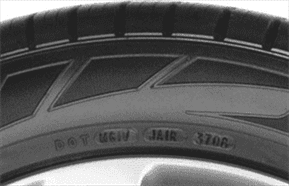 The next set of markings aren’t really necessary to know how to read your tires – but may be interesting at the same time – are important to the Department of Transportation (DOT) and are referred to as the Tire Identification Number (TIN). The TIN is made up of sets of letters and numbers. The first two letters/numbers are always representative of the manufacturing plant. Each plant gets a two digit code – whether it’s one number and one letter, both numbers, or both letters – and it will always be the first two markings you see to the right of DOT. The next part will be a two digit code indicating the tire size. The middle four letters, JAIR in our case, identify the tire brand. And finally the last four numbers tell you what week and year the tire was made. For our example, it was made during the 37th week of the year 2006.
There are certainly other numbers on the sidewall of your tires including maximum tire pressure (which is not the same as recommended tire pressure), temperature rating, traction rating and others. These are just making you aware that the tire, if used outside of those specifications, may not perform favorably.
The next set of markings aren’t really necessary to know how to read your tires – but may be interesting at the same time – are important to the Department of Transportation (DOT) and are referred to as the Tire Identification Number (TIN). The TIN is made up of sets of letters and numbers. The first two letters/numbers are always representative of the manufacturing plant. Each plant gets a two digit code – whether it’s one number and one letter, both numbers, or both letters – and it will always be the first two markings you see to the right of DOT. The next part will be a two digit code indicating the tire size. The middle four letters, JAIR in our case, identify the tire brand. And finally the last four numbers tell you what week and year the tire was made. For our example, it was made during the 37th week of the year 2006.
There are certainly other numbers on the sidewall of your tires including maximum tire pressure (which is not the same as recommended tire pressure), temperature rating, traction rating and others. These are just making you aware that the tire, if used outside of those specifications, may not perform favorably.
The next set of markings aren’t really necessary to know how to read your tires – but may be interesting at the same time – are important to the Department of Transportation (DOT) and are referred to as the Tire Identification Number (TIN). The TIN is made up of sets of letters and numbers. The first two letters/numbers are always representative of the manufacturing plant. Each plant gets a two digit code – whether it’s one number and one letter, both numbers, or both letters – and it will always be the first two markings you see to the right of DOT. The next part will be a two digit code indicating the tire size. The middle four letters, JAIR in our case, identify the tire brand. And finally the last four numbers tell you what week and year the tire was made. For our example, it was made during the 37th week of the year 2006.
There are certainly other numbers on the sidewall of your tires including maximum tire pressure (which is not the same as recommended tire pressure), temperature rating, traction rating and others. These are just making you aware that the tire, if used outside of those specifications, may not perform favorably.